Wondering how much the average wedding costs in the UK? Every year, Bridebook – the UK’s number one wedding planning app – surveys thousands of couples to uncover exactly how much it costs to get married, and how those costs are changing.
For our 2026 UK Wedding Report, we surveyed 7,000 newly married and actively planning couples, making this the largest and most comprehensive wedding cost dataset in the UK.
From venue and catering spend to guest numbers, dates and regional differences, this report breaks down where wedding budgets are really going – and what that means for couples planning today.
Whether you’re just starting to think about your budget, actively planning your day, or working in the wedding industry and looking for reliable data, this guide gives you the clearest picture of the average cost of a UK wedding in 2026.
TL;DR: The Average Cost of a Wedding in the UK (2026 Data)
Short on time? Here’s a quick snapshot of the key wedding cost insights from Bridebook’s 2026 research:
- The average UK wedding costs £20,604 in 2026
- That figure is broadly stable compared to 2025 (£20,822)
- Couples aren’t spending less – they’re spending more intentionally
- Guest count, location and date choice have the biggest impact on overall cost
Source: Bridebook’s UK Wedding Report 2026, based on a survey of 7,000 UK couples.
What is the average cost of a wedding in the UK in 2026?
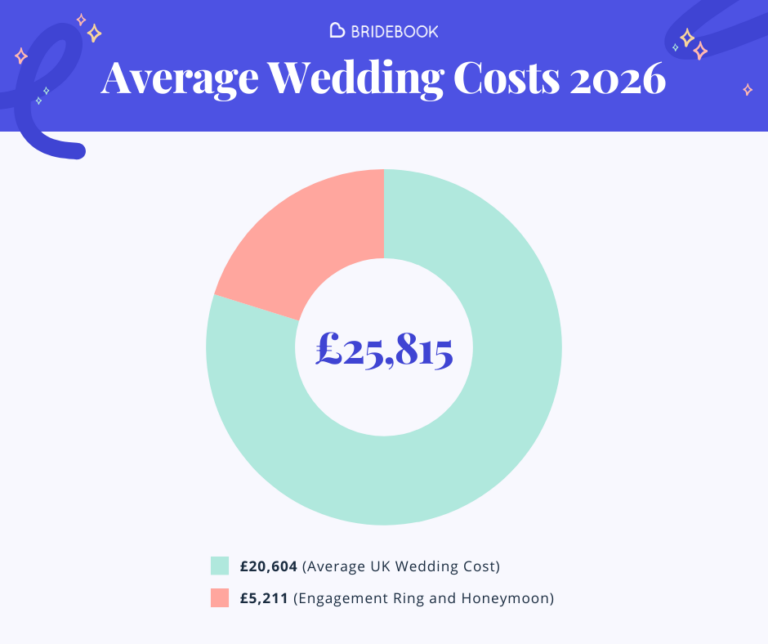
The average cost of a UK wedding in 2026 is £20,604, according to Bridebook’s latest data. This figure is based on responses from 7,000 couples, making it the most robust and representative snapshot of wedding spend in the UK today.
This typical £20,000 wedding budget is spread across a range of core elements, with the venue, catering and guest experience accounting for the largest share of spend.
On average, couples allocate their wedding budget as follows:
- Venue hire & catering: 51%
- Photography & videography: 10%
- Wedding attire: 19%
- Flowers & décor: 7%
- Entertainment: 7%
- Other suppliers & extras: 6%
It’s worth noting that this figure does not include the cost of the honeymoon or engagement ring, which are typically budgeted for separately.
Importantly, the average cost of a wedding has remained largely stable year-on-year. In 2025, the average was £20,822 – a difference that suggests couples are continuing to invest in their weddings, even amid wider cost of living pressures.
How Wedding Costs Have Changed Over Time
Bridebook’s long-running wedding survey allows us to track how wedding costs have evolved over time – and the story for 2026 is one of stability, not decline.
While wider economic pressures continue to affect day-to-day spending, the average cost of a UK wedding has remained remarkably consistent in recent years. In 2026, the average wedding costs £20,604, compared to £20,822 in 2025 and £20,775 in 2024, reinforcing that couples are still choosing to invest meaningfully in their celebrations.
Average UK wedding cost by year:
| Year | Average Spend (£) |
|---|---|
| 2026 | £20,604 |
| 2025 | £20,822 |
| 2024 | £20,775 |
| 2023 | £19,184 |
| 2022 | £16,529 |
Following a lower point in the years prior due to the pandemic, average wedding costs rose steadily through 2022 and 2023 as larger celebrations returned. Since 2024, costs have levelled off, indicating a period of relative stability, with couples adjusting how they spend, rather than how much they spend.
What Couples Are Actually Spending Their Wedding Budget On
So, we know the average cost of a wedding in 2026 is £20,604 – but what does that look like in practice?
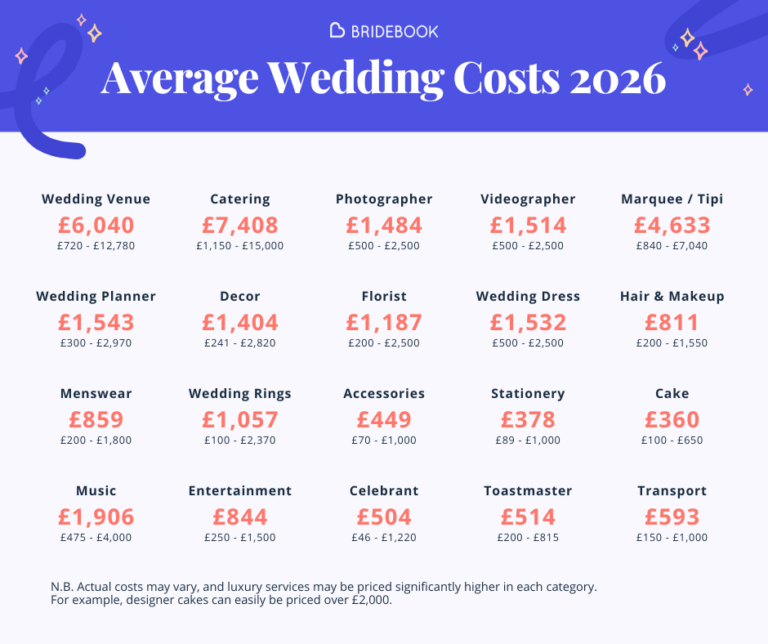
Wedding budgets are far from one-size-fits-all. These averages include a wide range of choices, from couples who DIY certain elements to those who prioritise premium suppliers.
With an average wedding budget of £20,604, couples continue to prioritise professional suppliers, even when making savings elsewhere.
Average supplier spend has remained broadly similar to last year, suggesting couples would rather reduce guest numbers or adjust dates than compromise on the quality of their wedding day team.
Average wedding spend by supplier (2026):
| Category | Average Spend (£) |
|---|---|
| Venue (excluding catering) | £6,040 |
| Catering – Reception | £5,406 |
| Catering – Evening | £2,002 |
| Marquee / Tipi | £4,633 |
| Wedding Planner | £1,543 |
| Dress | £1,532 |
| Photographer | £1,484 |
| Videographer | £1,514 |
| Decor | £1,404 |
| Florist | £1,187 |
| Music – Reception | £1,061 |
| Rings / Jewellery | £1,057 |
| Menswear | £859 |
| Music – Ceremony | £845 |
| Entertainment | £844 |
| Transport | £593 |
| Celebrant | £504 |
| Toastmaster | £514 |
| Stationery | £378 |
| Accessories | £449 |
| Cake | £360 |
| Make-up | £394 |
| Hair Styling | £417 |
- Combined venue and catering spend has seen the biggest year-on-year increase, with costs now averaging £117.10 per head, driven by rising food and staffing costs.
- Despite this, couples continue to value professional photography, videography and planning support.
- Couples with budgets under £10,000 are more likely to DIY or accept help from friends and family – particularly for décor, floristry, music and cakes.
When using these figures to plan your own wedding – or to benchmark as a supplier – it’s important to consider the context behind the numbers, including guest count, location and level of personalisation.
Average Wedding Cost by Guest Number
Guest numbers are one of the biggest drivers of wedding spend – and in 2026, couples are becoming increasingly selective about who makes the list.
To offset rising catering costs, many couples are choosing smaller, more intimate celebrations. In fact, 41% of wedding receptions now host fewer than 60 guests, up from 32% the year before.
While the average ceremony still includes around 74 guests, evening guest numbers have dropped sharply, bringing total guest lists under 100 for the first time since before the pandemic.
Average wedding cost by guest count:
- 50 guests: £15,162
- 70 guests: £21,791
- 100 guests: £22,510
Smaller guest lists allow couples to increase spend per head, often improving food, drink and overall guest experience without increasing total budget.
See below for a breakdown of average guest numbers at a UK wedding:
| Wedding Stage | Average Guests |
|---|---|
| Ceremony | 74 |
| Reception | Under 60 (41% of weddings) |
| Evening Guests | 21 |
| Additional Reception Guests | 6 |
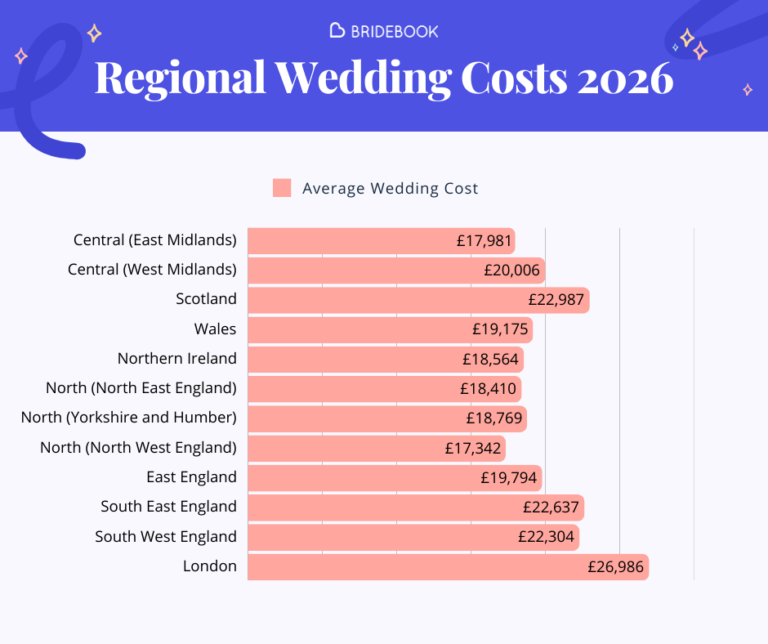
Where you choose to get married can have a significant impact on your wedding budget. From London and the South East to Scotland, average costs vary considerably.
Location continues to have a major impact on wedding spend. While average costs across much of England have remained stable, Bridebook’s data shows a growing north–south divide.
Scotland, in particular, has seen a notable rise in average wedding spend, driven in part by an increase in destination weddings from couples based in London and the South East.
Average UK wedding cost by region:
| Region | Average Spend (£) |
|---|---|
| Central (East Midlands) | £17,981 |
| Central (West Midlands) | £20,006 |
| Scotland | £22,987 |
| Wales | £19,175 |
| Northern Ireland | £18,564 |
| North (North East England) | £18,410 |
| North (Yorkshire and Humber) | £18,769 |
| North (North West England) | £17,342 |
| East England | £19,794 |
| South East England | £22,637 |
| South West England | £22,304 |
| London | £26,986 |
Understanding these regional differences can help couples set realistic expectations – and uncover opportunities to stretch their budget further.
Looking to start your venue search? Discover the best wedding venues local to you here.
Cheapest & Most Expensive Months to Get Married
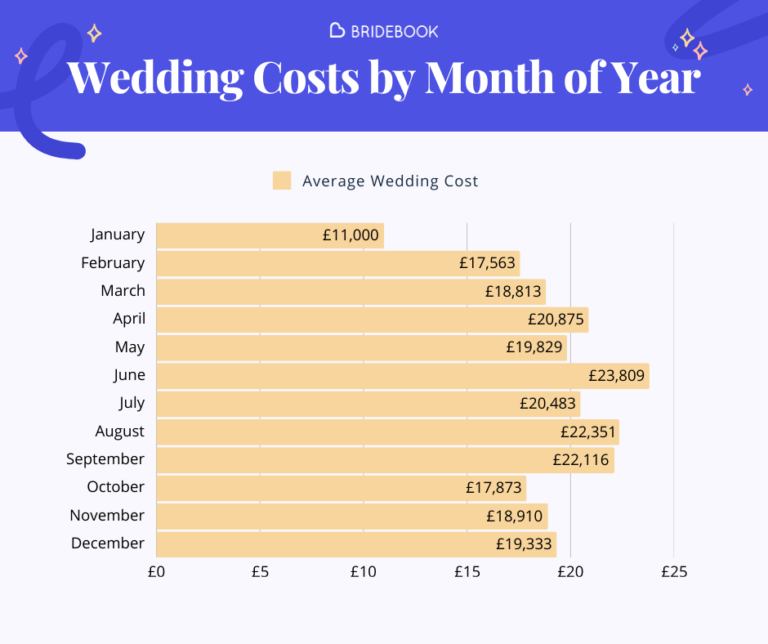
Seasonality still plays a major role in wedding pricing. While August remains the most popular month to get married, flexibility is becoming an increasingly common strategy for managing budgets.
Despite the traditional wedding season running from spring through summer, 19% of couples now choose off-peak dates, typically between October and March.
Weekday weddings are also on the rise. Less than half of all weddings now take place on a Saturday – the lowest proportion since before 2018 – with Wednesdays and Thursdays growing in popularity, particularly among Gen Z couples.
| Month | Average Spend (£) |
|---|---|
| January | £11,000 |
| Feburary | £17,563 |
| March | £18,813 |
| April | £20,875 |
| May | £19,829 |
| June | £23,809 |
| July | £20,483 |
| August | £22,351 |
| September | £22,116 |
| October | £17,873 |
| November | £18,910 |
| December | £19,333 |
According to Bridebook’s data:
- Most expensive months: June, August, September
- Cheapest months: January, February, October
Choosing an off-peak month or weekday can be one of the most effective ways to reduce venue and catering costs – without compromising on the celebration itself.
Working to a tighter wedding budget? Discover the best tips to cut costs without compromising your dream day in our ultimate cost-cutting guide.
Are couples spending less? Or spending smarter?
“Stable spend doesn’t mean couples are opting for less – it means they’re being far more intentional about where their money goes,” says Hamish Shephard, founder of Bridebook.
While some couples still find wedding costs challenging, the data shows a positive shift. More couples are staying within budget than in previous years, and fewer are overspending compared to 2024.
We’re seeing couples:
- Reduce guest numbers
- Choose off-peak or midweek dates
- Rethink traditions that don’t feel meaningful
For Gen Z in particular, this means prioritising experience and authenticity over convention – and creating celebrations that feel personal, not performative.
We’ve broken down the average wedding spend amount by percentage of couples below:
| Spend Level | % of Couples |
|---|---|
| £10,000 or under | 25% |
| £10,001 – £25,999 | 40% |
| £26,000+ | 25% |
| £35,000+ | 10% |
How Couples Are Making Their Wedding Budget Work Harder
Bridebook’s data highlights several practical ways couples are maximising value without sacrificing quality:
- Choosing off-peak months or weekdays
- Reducing guest numbers to increase spend per guest
- Opting for venues like restaurants, pubs or flexible spaces
- Prioritising key suppliers and simplifying décor
- Replacing traditions with personal alternatives
These strategies reflect a broader shift towards value-led planning, rather than budget-led compromise. Want more ways to save on your big day? Take a look at our ultimate cost-cutting guide.
FAQs: Average Cost of a Wedding in the UK
Still have questions about the average cost of a wedding in the UK? We asked Bridebook’s in-house wedding expert, Hamish Shephard, founder of Bridebook, to answer the most frequently searched questions couples ask about wedding spend.
How much does the average wedding cost in the UK in 2026?
The average cost of a UK wedding in 2026 is £20,604, according to Bridebook’s UK Wedding Report. This figure reflects the cost of the wedding day itself and does not include engagement rings or honeymoons.
When those are included, the total average spend rises to £25,815.
Has the average cost of a wedding gone up or down?
Wedding spend has remained broadly stable year on year. In 2025, the average wedding cost was £20,822, meaning there has been no significant increase despite ongoing cost of living pressures.
This stability suggests couples are adapting how they plan – not opting out of weddings, but making more intentional choices around guest numbers, dates and priorities.
Can you really get married for £10,000 in the UK?
Yes. 25% of couples spend £10,000 or less on their wedding, a proportion that has remained consistent since 2017.
Couples achieving this are more likely to:
- Reduce guest numbers
- Choose off-peak or weekday dates
- Opt for restaurants, pubs or non-traditional venues
- DIY or accept help from friends and family for certain elements
Do most couples go over their wedding budget?
Many couples still find wedding finances challenging, but the picture is improving.
- Just over half of couples went over budget in 2025
- 36% stayed within budget
- 1 in 17 couples came in under budget
This represents an improvement on 2024, when 62% of couples exceeded their original budget.
Who pays for weddings in the UK?
Family support plays a growing role in wedding budgets.
- 59% of couples receive financial contributions from family
- 31% receive 25-50% of their wedding costs from relatives
- 26% receive 50-75%
- 15% receive more than 75%
As a result, 36% of couples personally contribute £10,000 or less, and nearly three quarters contribute £20,000 or less.
Why are guest numbers getting smaller?
Rising catering costs – now averaging £117.10 per head – are one of the biggest factors influencing guest lists.
In 2025:
- 41% of wedding receptions had fewer than 60 guests
- Evening guest numbers dropped sharply
- Total guest lists fell below 100 for the first time since before the pandemic
Couples are choosing smaller celebrations to protect their budget while enhancing the guest experience.
Are Gen Z couples spending less on weddings?
Yes – but by choice, not compromise.
Gen Z couples spend around 12% less on average than older age groups. This is largely driven by:
- A preference for Monday–Thursday weddings
- Smaller guest lists
- Less emphasis on tradition where it doesn’t feel meaningful
It’s also important to consider that Gen Z are still in their 20s and therefore are not as likely to be as financially established as millennials.
What’s the biggest cost when planning a wedding?
For most couples, the venue and catering account for the largest proportion of wedding spend, followed by photography, attire and entertainment.
Couples tend to prioritise professional suppliers and reduce guest numbers rather than compromise on quality.
The Bottom Line on Wedding Costs in 2026
The average cost of a UK wedding in 2026 is £20,604 – but that figure is best seen as a benchmark, not a blueprint.
Couples are continuing to invest in their weddings, but with greater clarity, confidence and intention.
With the right information, tools and flexibility, it’s entirely possible to plan a wedding that feels personal, meaningful and financially manageable.
Ready to kickstart your wedding planning? From checklists to budget calculators to your guest list, Bridebook has everything you need to plan your big day without the stress (or overspending!). Sign up now and get started today!
The Average Cost of a Wedding in 2025 Was £20,822
In 2025, the average cost of a wedding in the UK was £20,822, rising to £26,583 when including the engagement ring and honeymoon.
The data, collected from around 7,000 couples, revealed key differences in spending patterns:
- Gen Z couples tended to spend less overall (£19,095 on average) and were more likely to spend under £10,000 than non-Gen Z couples
- Around a quarter of couples spent less than £10,000, while the top 10 % spent over £38,000, showing a widening range of wedding budgets
- Average supplier costs showed that venue and catering were the biggest portion of wedding spend, with the average venue (including catering) costing about £9,811, far more than other categories like photography or videography
2025 UK Wedding Costs by Category
- Venue hire (including catering) – £9,811 / (venue only) – £5,945
- Catering (reception) – £5,395 / (evening) – £1,840
- Photography – £1,482
- Videography – £1,386
- Flowers – £1,132
- Wedding cake – £365
- Wedding dress – £1,515
- Wedding menswear – £845
- Fashion & accessories – £379
- Wedding rings & jewellery – £955
- Hairdressing – £358
- Makeup – £363
- Music (ceremony) – £821 / (reception) – £1,102
- Entertainment (non-music) – £704
- Wedding stationery – £413
- Decor & hire – £1,271
- Marquee / tipi – £4,532
- Transport – £626
- Wedding favours – £158
- Wedding planner – £1,892
- Celebrant – £546 / Toastmaster – £477
- Engagement ring – £2,158
- Honeymoon – £4,608
Source: Bridebook’s UK Wedding Report 2025, based on a survey of 7,000 UK couples.
The Average Cost of a Wedding in 2024 Was £20,775
In 2024, the average cost of a wedding in the UK was £20,775, rising to £25,952 when including the engagement ring and honeymoon.
The data, collected from around 6,000 couples, revealed key differences in spending patterns:
- Gen Z couples were more affected by economic pressures but still expected to spend more than previous generations, often investing an extra £4,000 on their weddings while finding creative ways to save, such as upcycling decor or reselling items
- Around a quarter of couples spent less than £10,000, while the top 10 % spent over £38,000, showing a wide range of wedding budgets
- Guest count had a major impact on costs, with couples hosting 50 guests or fewer spending around £12,006, while those with 150+ guests spent £37,431 on average
2024 UK Wedding Costs by Category
- Venue hire (including catering) – £9,877 / (venue only) – £6,084
- Catering (reception) – £5,732 / (speciality) – £1,097
- Photography – £1,464
- Videography – £1,439
- Flowers – £1,182
- Wedding cake – £405
- Wedding dress – £1,309
- Wedding menswear – £764
- Fashion & accessories – £285
- Wedding rings & jewellery – £2,089 (engagement ring) / £1,021 (other jewellery)
- Hairdressing – £358
- Makeup – £328
- Music (ceremony) – £641 / (reception) – £1,127
- Entertainment (non-music) – £727
- Wedding stationery – £384
- Decor & hire – £1,449
- Marquee / tipi – £4,202
- Transport – £705
- Wedding favours – £158
- Wedding planner – £2,436
- Celebrant – £501 / Toastmaster – £515
- Honeymoon – £4,329
Source: Bridebook’s UK Wedding Report 2024, based on a survey of 6,000 UK couples.
You Might Also Like…
- The Ultimate Wedding Budget Breakdown
- Introduction: Your Wedding Budget
- How to Save Money on Your Wedding: The Ultimate Cost-Cutting Guide
- Hidden Wedding Costs Every Couple Needs To Know About
- How to Ask Your Parents for Wedding Money